
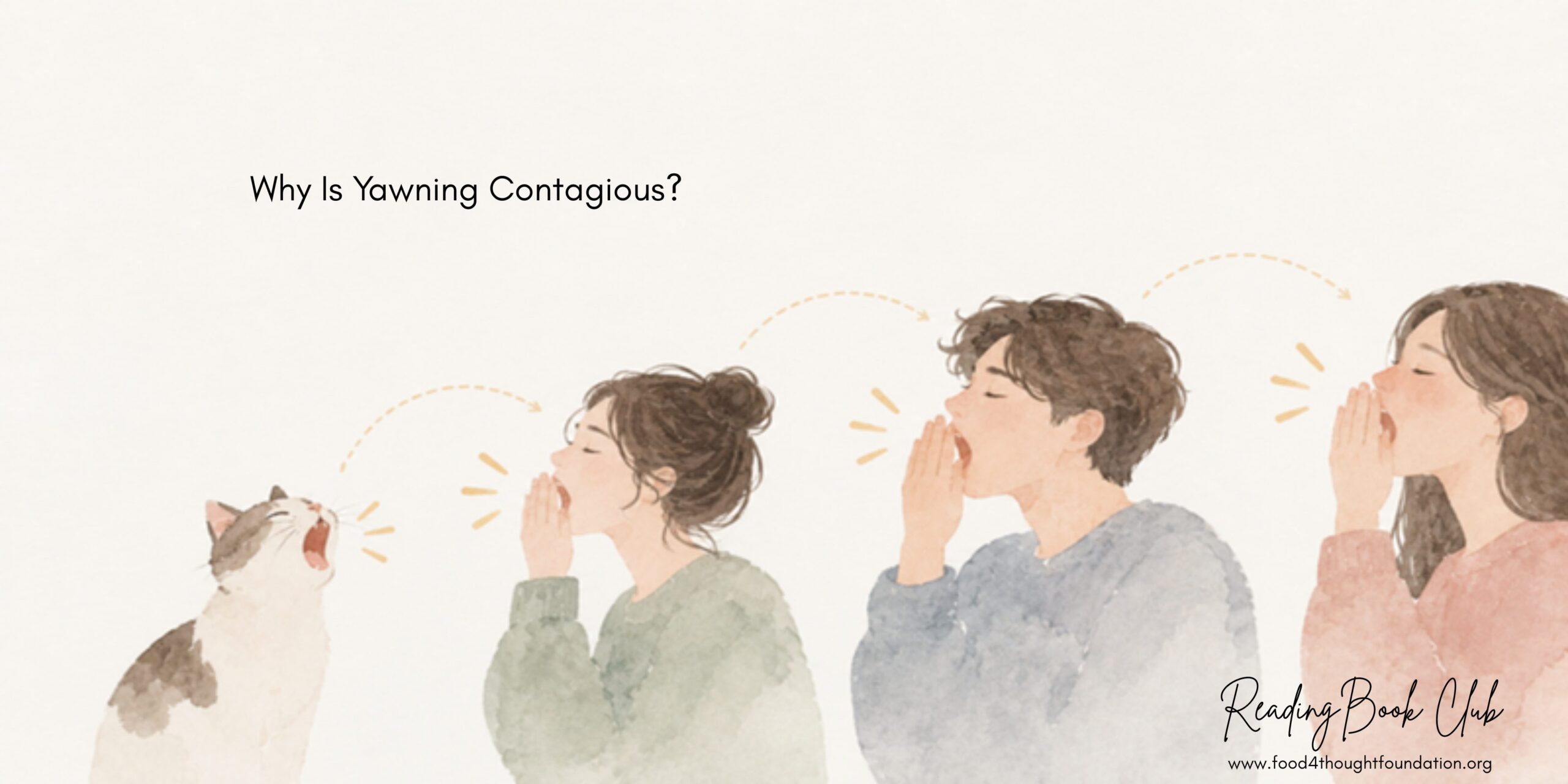
Try reading this article without yawning.
That sentence may already have made you think about doing it.
Someone across the classroom yawns.
A few seconds later, another person yawns.
Then someone else does.
Soon half the room appears ready for bed.
Why?
Yawning itself is ancient behaviour found across many vertebrate species, but scientists still debate exactly why we do it. Reviews of the evidence have considered explanations involving breathing, alertness, temperature regulation and communication, without finding one simple theory that explains everything.
Contagious yawning is a more specific puzzle.
It happens when seeing, hearing or even thinking about a yawn increases the urge to yawn ourselves.
Researchers have studied the brain while people watch other people yawn. One imaging study found increased activity in areas involved in processing social cues, although it did not support the simple idea that contagious yawning is just ordinary imitation through the brain’s classic mirror-neuron system.
Another experiment used transcranial magnetic stimulation to investigate the motor system and found evidence connecting contagious yawning with differences in cortical excitability.
In simpler terms, your brain does not merely see a yawn.
For some people, observing it appears to activate systems that make performing the same behaviour more likely.
Is it because we are empathetic?
You may have heard that people who yawn contagiously are more empathetic.
There has been research exploring links between contagious yawning and social cognition. Some studies have proposed relationships with processes involved in understanding other people.
However, science is rarely as simple as a social-media fact saying:
“If you don’t yawn, you have no empathy.”
Human behaviour depends on many factors, and researchers are still investigating precisely why some people respond more strongly than others.
Contagious yawning has even been triggered through sound in experiments, meaning that seeing a wide-open mouth is not necessarily required.
So what is actually happening?
The safest answer is:
We know contagious yawning is real.
We know the brain responds differently when observing yawns.
We know motor and social-processing systems appear to be involved.
But we do not yet have one perfect explanation for why the phenomenon exists.
And that may be the most interesting part.
Something we experience casually every day can still contain unanswered scientific questions.
So the next time someone yawns during class and you immediately follow them, perhaps do not blame the lesson.
Blame your extremely suggestible brain.
Sources: PubMed research and reviews on yawning, contagious yawning, cortical excitability and social processing.