
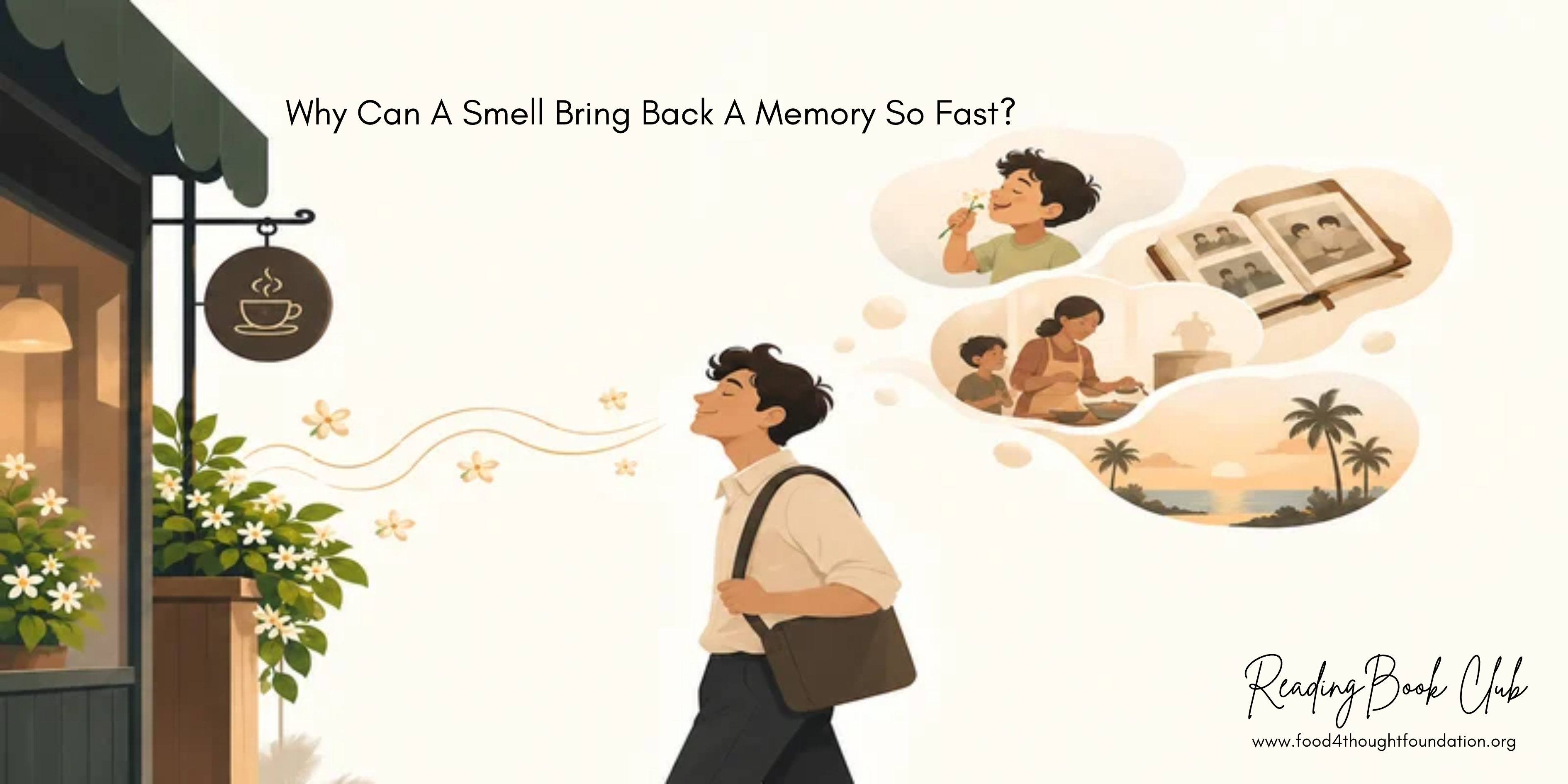
You walk past a bakery.
For one second, you smell something familiar.
Suddenly you are eight years old again.
You remember a kitchen.
A person.
A holiday.
Maybe even a feeling you had forgotten existed.
Nothing else seemed to trigger that memory.
Then one smell opened the door.
Why?
Scientists have studied the unusual relationship between smell and autobiographical memory for decades.
Research suggests that memories triggered by smells can feel particularly emotional and can create a strong sensation of being transported back into the past.
This phenomenon is sometimes called the Proust effect, after writer Marcel Proust famously described a taste and smell unexpectedly releasing a flood of childhood memories.
Modern research continues to examine why scent and taste can generate such powerful nostalgia. A 2023 review described smell- and taste-triggered nostalgic memories as especially self-relevant, familiar and emotionally arousing.
What makes smell different?
Part of the answer may be anatomy.
The brain systems involved in processing smell have close connections with structures important for emotion and memory, including the amygdala and hippocampus.
That does not mean every smell automatically creates a powerful memory.
Most smells disappear from attention quickly.
But when a scent has become linked to an important experience, meeting that smell again can reactivate an entire network of associations.
Fresh rain may remind one person of school holidays.
Another person may think of football practice.
Someone else may remember nothing at all.
The smell itself is not carrying the memory.
Your experience has given it meaning.
Why do some smell-memories feel so old?
Research on autobiographical memory has found an interesting pattern: memories triggered by odours can often come from earlier periods of childhood than memories triggered through words or images. They may also feel unusually vivid or emotional.
Researchers continue to investigate how familiarity affects this process. Recent work suggests that highly familiar odours can benefit from the large amount of personal and conceptual information already associated with them.
Think about the smell of your grandmother’s cooking.
A particular soap used in your childhood home.
Old library books.
Incense.
A school corridor after rain.
The moment your brain recognises that scent, it may retrieve far more than the smell itself.
It retrieves context.
Can we control it?
Sometimes.
People deliberately use familiar scents to create atmosphere or comfort.
But some of the most powerful smell memories arrive without permission.
That is what makes them fascinating.
Memory is not a perfectly organised folder we open when we need information.
Sometimes the past is waiting in places we never thought to search.
Including the air.
Sources: NCBI/PubMed research and reviews on autobiographical odour memory, olfactory neuroscience and the Proust effect.