
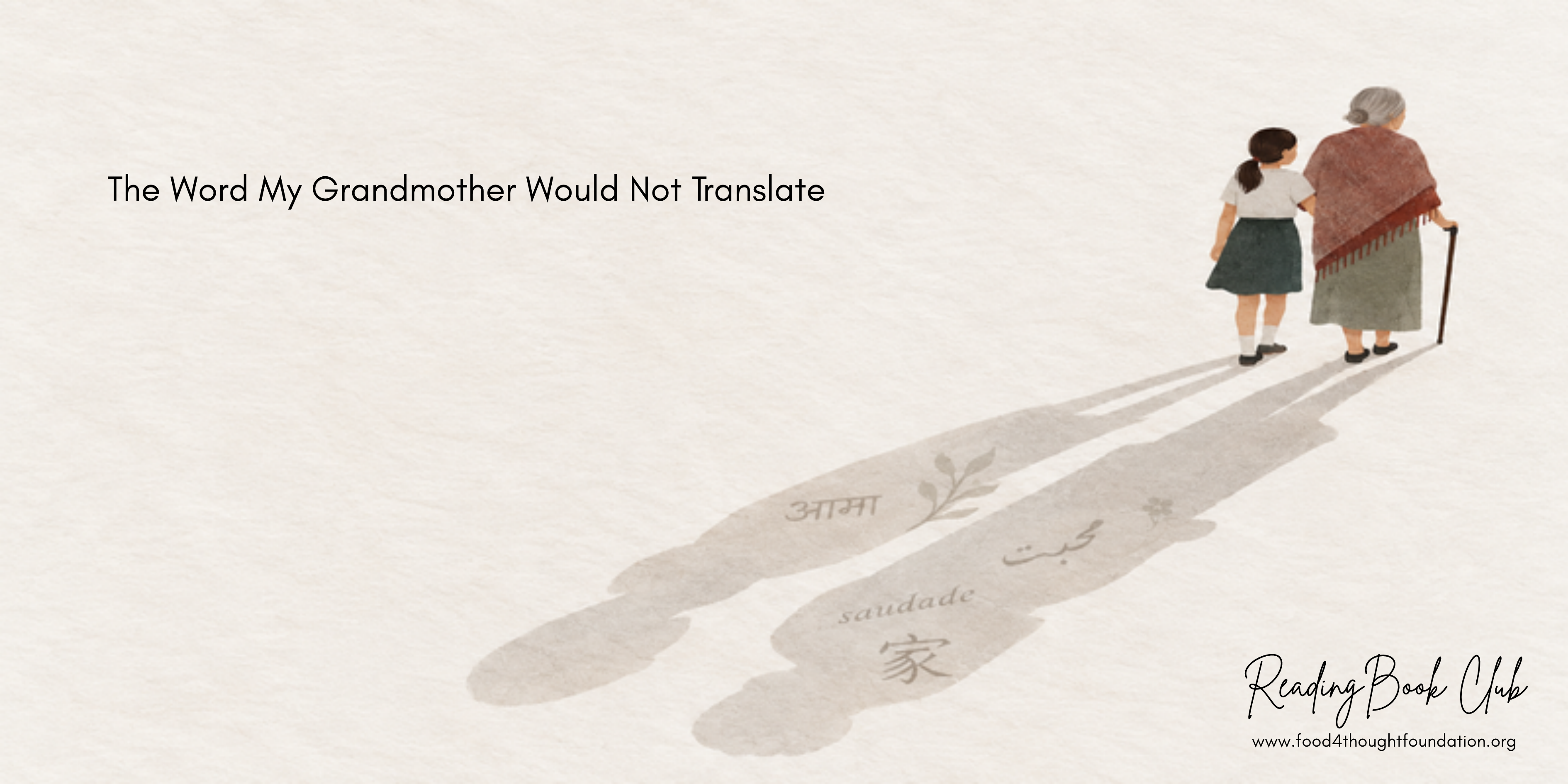
My grandmother speaks English perfectly well.
She simply refuses to use it for certain things.
“What’s the English word for this?” I once asked while she was serving dinner.
She looked at the bowl.
Then at me.
“There isn’t one.”
“There has to be.”
“There doesn’t.”
I thought she was being difficult.
The word was from the language she had grown up speaking. I wanted an English equivalent for a school assignment.
So I tried possibilities.
Comfort?
Warmth?
Affection?
Hospitality?
She rejected all of them.
“Those are pieces,” she said. “Not the whole thing.”
That answer annoyed me.
Languages were supposed to translate.
That was the point.
Wasn’t it?
Later, I began noticing how often the problem appeared.
There were words my grandparents used for relationships that English reduced to “aunt” or “uncle.”
Words for different kinds of affection.
Expressions that sounded hilarious at home but strangely lifeless when translated directly.
Even scolding changed.
My grandmother could complain about me in our family language and somehow make it sound affectionate.
In English, the same sentence sounded like she was preparing a legal case.
Slowly, I understood what she meant.
Translation is not replacing one word with another.
Words carry histories.
They carry jokes.
Food.
Places.
Relationships.
Sometimes they carry the voice of the person who used them first.
India contains hundreds of languages and countless regional ways of speaking. Many of us move between languages without even noticing.
English at school.
Another language with grandparents.
A mixture with friends.
A completely invented vocabulary in family WhatsApp groups.
That movement is not confusion.
It is richness.
I eventually submitted my assignment.
Beside my grandmother’s word, I wrote a short explanation instead of a single English translation.
My teacher accepted it.
Grandmother examined the paper.
“So now you understand?”
“A little.”
She smiled.
“Good.”
Then she used the word again.
This time, I did not ask for the English version.
Some words do not need to cross over completely.
Sometimes understanding where they belong is enough.